Every business develops routines over time.
Someone creates a spreadsheet. Another employee starts copying information between systems. A manual approval step gets added. Before long, everyone is working around the process instead of benefiting from it.
Because these changes happen gradually, it’s easy to miss how much they cost.
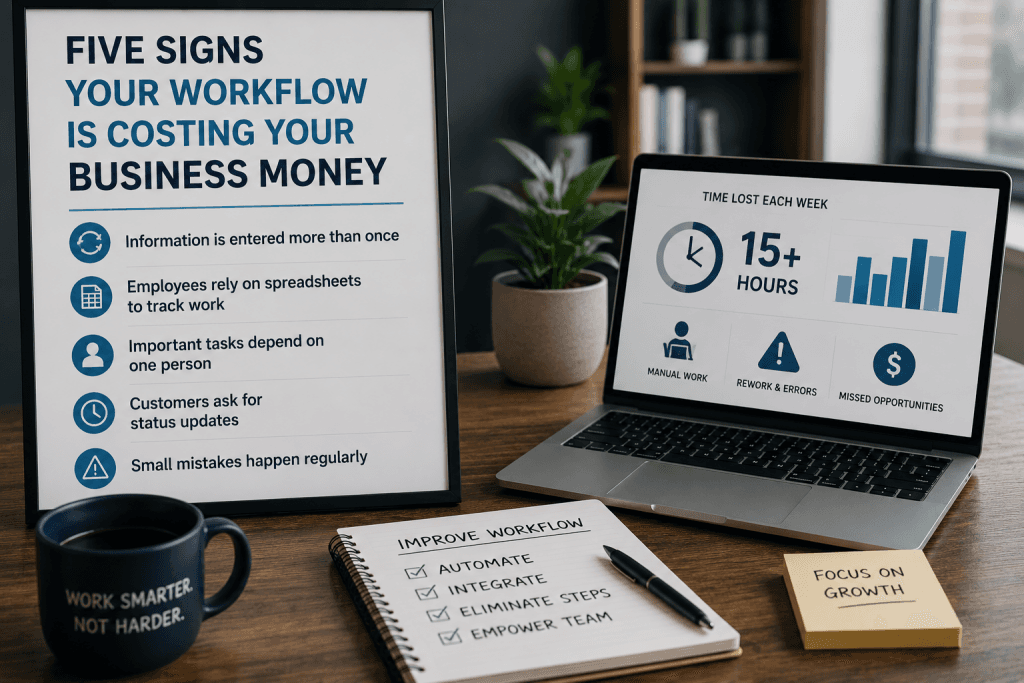
Here are five warning signs.
1. Information is entered more than once.
Whenever employees copy information from one system into another, mistakes become inevitable.
Duplicate data entry also consumes valuable time that could be spent serving customers or improving the business.
2. Employees rely on spreadsheets to track work.
Spreadsheets are excellent analysis tools.
They are far less effective as workflow management systems.
When multiple people maintain different copies, it quickly becomes difficult to determine which information is current.
3. Important tasks depend on one person.
If only one employee knows how a process works, the business becomes vulnerable whenever that person is unavailable.
Well-designed systems reduce this dependency by documenting and automating routine work.
4. Customers ask for status updates.
Frequent “just checking in” emails often indicate that customers aren’t receiving enough visibility into the process.
Automated notifications and better communication can significantly improve customer confidence.
5. Small mistakes happen regularly.
Minor errors may seem harmless individually.
Together, they create rework, delays, frustration, and unnecessary expense.
Most businesses underestimate how much these small issues accumulate over the course of a year.
Improving Workflows Doesn’t Always Mean Buying New Software
Many workflow improvements come from connecting existing systems more effectively.
Automation, integrations, and thoughtful process design often provide greater returns than replacing everything with a new platform.
Key Takeaways
The most expensive workflow problems are rarely dramatic.
They’re the small, repetitive inefficiencies that quietly consume time every day.
Identifying and removing those friction points is often one of the fastest ways to improve productivity without increasing staff.
Small inefficiencies rarely stay small. As businesses grow, manual processes often become hidden costs that consume time, create errors, and frustrate both employees and customers.